
Table of Contents
What Is Supply Chain Management?
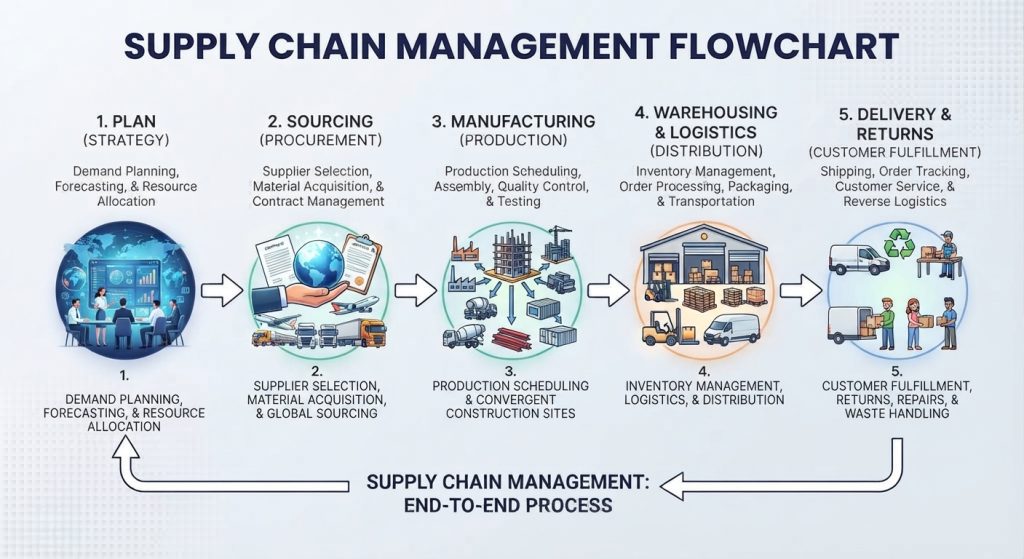
A supply chain is the full network of organizations, people, activities, and resources involved in moving a product or service from raw material to end customer. It’s not one company — it’s a chain of companies, each doing one part of the work and handing off to the next.
A typical supply chain includes:
- Raw material suppliers — the source of unprocessed inputs (timber, iron ore, cotton, aggregate).
- Manufacturers/producers — convert raw materials into components or finished products (a cement plant, a steel mill, a factory).
- Distributors/wholesalers — buy in bulk and break it down into smaller quantities for downstream buyers.
- Retailers or contractors — the point where the product reaches the party who will use or sell it to the end customer (a hardware store, a general contractor procuring materials for a project).
- End customers — the ultimate consumer of the product or the completed structure.
- Reverse logistics — the flow moving backward: returns, repairs, recycling, and waste handling.
Supply chains vary enormously in shape. Some are short and simple — a farmer selling directly at a local market has almost no intermediate links. Others are long and multi-tiered — a smartphone’s supply chain can span dozens of countries and hundreds of component suppliers before final assembly. Construction supply chains sit somewhere distinctive: they’re project-based and temporary, reassembled for each new site, and they converge — many different material and component streams (concrete, steel, glazing, mechanical systems) have to arrive at one physical location in the right sequence, rather than flowing toward a centralized factory. That convergence, combined with the fact that the “factory” is a construction site that changes every project, is a large part of why construction supply chains behave differently from manufacturing ones — a distinction covered in more depth further down.
Supply Chain Management vs Logistics: What Is the Difference?
These two terms get used as if they’re interchangeable, but they aren’t, and the Council of Supply Chain Management Professionals (CSCMP) — the field’s leading professional body — draws the line explicitly in its own definitions.
CSCMP defines supply chain management as “the active management of supply chain activities to maximize customer value and achieve a sustainable competitive advantage,” encompassing “everything from product development, sourcing and production to logistics, as well as the information systems needed to coordinate these activities”.
Logistics management, in CSCMP’s own words, “is that part of supply chain management that plans, implements, and controls the efficient, effective forward and reverse flow and storage of goods, services and related information between the point of origin and the point of consumption to meet customers’ requirements”.
Read those two definitions side by side and the relationship becomes clear: logistics is a subset of supply chain management, not a synonym for it. Logistics is specifically about moving and storing things — transportation, warehousing, inventory, order fulfillment. Supply chain management is the broader discipline that also includes sourcing decisions, supplier relationships, production planning, demand forecasting, and the strategic question of how the whole network should be designed in the first place. Every logistics operation happens inside a supply chain, but a supply chain manager’s job is bigger than logistics alone — it includes deciding which suppliers to use, how much inventory to hold and where, and how to coordinate partners who don’t report to the same organization.
What Are the 5 Key Components of Supply Chain Management?
The most widely used framework for breaking SCM into functional components is the Supply Chain Operations Reference (SCOR) model, developed originally in 1996 and maintained today by ASCM (the Association for Supply Chain Management, formerly APICS). The classic SCOR model organizes supply chain activity into five core process categories:
- Plan — balancing aggregate supply and demand to determine the best course of action for meeting sourcing, production, and delivery requirements. This is where demand forecasts, inventory targets, and capacity decisions get made.
- Source — procuring the goods and services needed to meet planned or actual demand: selecting suppliers, negotiating contracts, and managing purchase orders.
- Make — transforming raw materials or components into a finished product ready to meet demand. In construction terms, this maps loosely onto on-site or off-site fabrication and assembly.
- Deliver — getting the finished product or service to the customer, covering order management, transportation, warehousing, and distribution.
- Return — handling product returns, repairs, and post-delivery customer support, in either direction of the chain.
A more recent version of the SCOR model (2022 onward) added a sixth category, Enable (sometimes called Orchestrate), covering the supporting management processes — business rules, performance measurement, data governance, contracts, risk management, and regulatory compliance. Whether you count five components or six, the underlying logic is the same: plan the work, get the inputs, transform them, get the output to the customer, and handle what comes back.
Types of Supply Chains: Examples and Applications
Not every supply chain should be designed the same way, and one of the most influential ideas in the field comes from Marshall Fisher’s 1997 Harvard Business Review article, “What Is the Right Supply Chain for Your Product?” Fisher argued that supply chain mismatches — not poor execution — are the root cause of many supply chain failures, because companies apply one generic “best practice” model to products that actually need very different treatment.
Fisher’s framework splits products into two categories based on demand predictability:
- Functional products — stable, predictable demand and long life cycles (staple groceries, basic construction materials like standard-grade rebar or cement).
- Innovative products — volatile, hard-to-forecast demand and short life cycles (fashion apparel, new electronics, custom or highly specified building components).
And it pairs each with a matching supply chain type:
- Efficient (physically efficient) supply chains — optimized to minimize cost through lean operations, economies of scale, and high asset utilization. Best suited to functional products where demand is predictable enough that cost minimization is the priority.
- Responsive (market-responsive) supply chains — optimized for speed and flexibility, able to react quickly to unpredictable demand even at higher cost. Best suited to innovative products where being out of stock or missing a trend costs more than carrying extra flexibility.
Beyond Fisher’s framework, supply chains are also commonly grouped by industry application: retail and consumer goods (high volume, standardized), pharmaceutical and cold-chain (temperature control, strict regulatory traceability), fashion (extremely short life cycles, responsive by necessity), and construction/project-based supply chains (temporary, site-specific, converging, and typically organized around a single project rather than a repeating production line). A civil engineering project procuring structural steel usually needs something closer to the “efficient” model for standard sections, and closer to “responsive” for custom-fabricated or specified components with long lead times — which is exactly the kind of mismatch Fisher’s framework is designed to catch.
How Does a Supply Chain Work? From Supplier to Customer
Supply chain planning is the “Plan” process from SCOR expanded into its own discipline: the set of activities that determine what needs to be produced, procured, and delivered, in what quantities, and by when, in order to meet expected demand without over- or under-committing resources.
It typically operates at three time horizons. Strategic planning covers network design decisions — where to locate facilities, which suppliers to use long-term, how much capacity to build. Tactical planning, often formalized as Sales and Operations Planning (S&OP), balances demand forecasts against available supply on a monthly or quarterly basis. Operational planning covers the near-term execution — scheduling specific production runs, placing specific purchase orders, routing specific shipments.
Good supply chain planning depends on demand forecasting accuracy, visibility into supplier lead times and capacity, and realistic inventory policy — how much safety stock to hold against forecast error versus how much cost that stock ties up. In construction, planning takes the form of procurement schedules tied to the master project schedule: ordering long-lead-time items (structural steel, specialized mechanical equipment, custom precast) far enough in advance that they arrive when the schedule needs them, not before (incurring storage and handling costs) and not after (delaying the work).
What Is Supply Chain Planning?
Strip away the jargon and a supply chain works through a repeating cycle: demand signals flow one direction (usually from customer back toward supplier), and physical goods flow the other direction (from supplier toward customer), with information, money, and — increasingly — returns and waste moving alongside both.
A simplified walk-through: a customer places an order (or a forecast predicts one). That demand signal triggers the “Plan” process, which determines what needs to be sourced and produced. “Source” processes procure raw materials or components from suppliers. “Make” processes convert those inputs into a finished product. “Deliver” processes move the finished product through warehouses, distribution centers, and transportation networks until it reaches the customer. If something goes wrong — a defect, an over-order, a change of mind — “Return” processes handle the reverse flow.
In a construction project, the same cycle looks like this: a project schedule and bill of materials generate demand for specific quantities of materials at specific times (Plan). Procurement issues purchase orders to suppliers and subcontractors (Source). Off-site fabrication or on-site assembly turns raw materials into installed work (Make). Materials, equipment, and labor are coordinated to arrive at the site in the sequence construction actually needs them (Deliver). And defective materials, over-ordered stock, or demolition waste move back out of the system (Return). The mechanics are the same as a retail supply chain; what’s different is that the “customer” is a fixed location and a construction schedule, not a distribution network, which is why sequencing and just-in-time delivery matter so much on site.
What Is Supply Chain Coordination?
Supply chain coordination is the practice of aligning the decisions, information, and incentives of separate organizations within a supply chain so the chain as a whole performs better than it would if each party optimized only for itself. It matters because a supply chain is made up of independent companies with their own goals, and without deliberate coordination, locally rational decisions can produce a collectively bad outcome.
The clearest illustration of what happens without coordination is the bullwhip effect, first formally analyzed by Lee, Padmanabhan, and Whang (1997). They documented how small, steady fluctuations in actual consumer demand get amplified into much larger order swings as they move upstream through a supply chain — a distributor sees modest retail sales variation, but the manufacturer supplying that distributor sees wild order swings, even though the underlying consumer demand barely changed. The paper identifies four operational causes: demand forecast updating (each tier forecasts off the order pattern of the tier below it, amplifying noise at every step), order batching (companies place large, infrequent orders to save on transaction or shipping costs, creating artificial spikes), price fluctuations (promotions trigger forward-buying, which then creates a demand trough once the promotion ends), and rationing/shortage gaming (buyers exaggerate orders during perceived shortages, then cancel once supply normalizes). The consequence, per the same study, is inflated inventory (sometimes over 100 days of supply in affected industries), poor capacity utilization, and higher transportation costs — all without any single participant behaving irrationally given the information available to them.
Coordination mechanisms exist specifically to counter this: shared point-of-sale data so upstream partners forecast off real consumer demand instead of order history, vendor-managed inventory, collaborative planning agreements, and stable pricing that removes the incentive for forward-buying. The common thread is information sharing — the bullwhip effect is fundamentally a problem of distorted information, not bad intentions.
What Is Supply Chain Visibility and Why Does It Matter?
Supply chain visibility is the ability to identify, track, and monitor activity across a supply chain — knowing where materials, shipments, and inventory actually are, and what condition they’re in, at any given stage rather than only at the points you directly control. It ranges from basic data (lead times, supplier locations, shipment status) to more complex tracking (sub-tier supplier risk, regulatory compliance, environmental impact) depending on how far into the chain an organization needs to see.
Visibility matters because most supply chain risk doesn’t originate at the tier a company directly buys from — it originates further upstream, at a sub-supplier or raw-material source that’s invisible without deliberate effort to track it. Without visibility, disruptions surface as a crisis (a shipment simply doesn’t arrive) rather than as an early warning (a supplier’s supplier reported a delay three weeks ago). Gartner has promoted the concept of a “control tower” — a combination of people, process, data, and technology intended to give organizations real-time visibility across the supply chain rather than siloed visibility limited to their own operations. In construction terms, visibility is the difference between finding out a structural steel shipment is four weeks late the day it was due on site, versus finding out when the mill first falls behind on the mill order — one gives a project team time to resequence work; the other doesn’t.
Push vs Pull Supply Chain: Key Differences
Push and pull describe two opposite strategies for deciding when production happens relative to actual customer demand, and the boundary between them is called the decoupling point — the last point in the supply chain where inventory is held before it’s committed to a specific customer order.
Push systems operate upstream of the decoupling point: production is forecast-driven, goods are made in anticipation of demand, and finished (or semi-finished) inventory is held ready to ship. This enables economies of scale and fast delivery from stock, but carries forecast risk — get the forecast wrong and you’re left with excess inventory or a stockout.
Pull systems operate downstream of the decoupling point: production doesn’t start until a confirmed customer order triggers it. This minimizes overproduction and inventory carrying cost and allows customization, at the cost of longer lead time to the customer.