
Table of Contents
What Is Graphene?
Graphene is a single layer of carbon atoms arranged in a two-dimensional hexagonal lattice — a honeycomb pattern, one atom thick. Each carbon atom bonds to three neighboring atoms through strong covalent sp² bonds, with a fourth electron in each atom delocalized across the sheet, free to move and carry charge.
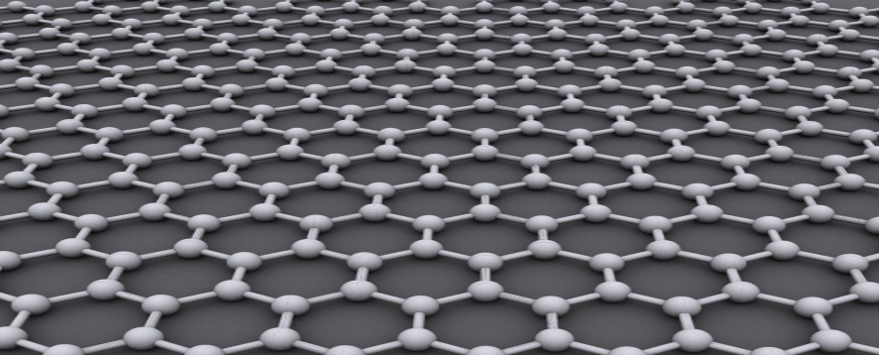
It was first isolated and characterized in 2004 by Andre Geim and Konstantin Novoselov at the University of Manchester, who used adhesive tape to repeatedly peel layers off a block of graphite until they were left with flakes just one atom thick — a technique now generally called mechanical exfoliation. The pair won the 2010 Nobel Prize in Physics for the discovery. What made the finding significant wasn’t just isolating a single atomic layer of carbon — it was that this 2D form turned out to have mechanical, electrical, and thermal properties that don’t just scale down from graphite; several of them are class-leading among all known materials, which is the thread running through the rest of this guide.
How Is Graphene Made? Production Methods Explained
Different production methods trade off quality against scale, and which one makes sense depends entirely on the application — research-grade electronics need something very different from a bulk additive for concrete.
Mechanical exfoliation. The original method: using an adhesive (classically, tape) to physically peel layers from graphite until single- or few-layer flakes remain. It produces the highest-quality, most defect-free graphene, but only in small, inconsistent flake sizes — suitable for fundamental research, not manufacturing.
Liquid-phase exfoliation (LPE). Graphite is dispersed in a solvent and broken apart — via sonication, shear mixing, or intercalation compounds — into graphene and few-layer graphene flakes suspended in liquid. It’s simpler and more scalable than mechanical exfoliation, making it the method generally used for bulk or large-scale production, including graphene destined for composites and additives.
Chemical vapor deposition (CVD). A bottom-up method: a hydrocarbon gas decomposes on a hot metal substrate — typically copper or nickel — and carbon atoms assemble into a continuous graphene film on the surface. CVD produces large-area, high-quality, structurally consistent graphene, but requires tight control of temperature, pressure, and gas flow, which makes it better suited to high-value applications like electronics than to bulk material production.
Epitaxial growth on silicon carbide. Heating silicon carbide under controlled conditions causes silicon atoms to sublime off the surface, leaving a carbon-rich layer that reorganizes into graphene. This method offers strong structural control directly on a semiconductor-compatible substrate, which matters for certain electronic device applications.
There’s no single “best” method — a materials scientist producing graphene oxide for a concrete admixture and one growing graphene for a transistor are, in practice, using entirely different production pipelines suited to entirely different quality and cost requirements.
Why Is Graphene So Strong? The Science Behind Its Strength
Graphene’s strength comes directly from its bonding geometry. Each carbon atom’s three in-plane sp² bonds are among the strongest single covalent bonds found in nature, and the honeycomb lattice arranges them so that a tensile load applied within the plane has to break those bonds directly — there’s no weaker secondary structure for a crack to exploit, the way there is in most engineering materials.
In 2008, Changgu Lee, Xiaoding Wei, Jeffrey Kysar, and James Hone at Columbia University measured this directly, using an atomic force microscope to indent suspended, defect-free graphene membranes to failure. They reported a Young’s modulus of approximately 1.0 TPa (terapascal) and an intrinsic breaking strength of 130 GPa (gigapascal) — the highest strength ever measured for any material at the time of publication. James Hone later put the comparison in terms most people can picture: graphene is “some 200 times stronger than structural steel” by this measure, and famously illustrated it by saying it would take “an elephant, balanced on a pencil,” to puncture a sheet of graphene as thin as plastic wrap.
Two caveats worth keeping in mind. First, these are values for a single, defect-free crystalline layer under controlled laboratory conditions — not a bulk graphene product. Second, “strength” here specifically means resistance to being pulled apart (tensile strength), which is a different property from hardness (resistance to being scratched or indented) — a distinction that matters a great deal once graphene gets compared to diamond, further down.
Graphene vs Graphite: What Is the Difference?
Graphite is what you get when you stack hundreds of thousands of graphene layers on top of each other. Within each layer, the same strong sp² carbon-carbon bonds are present (bond length about 0.142 nm), but the layers themselves are held together only by weak van der Waals forces, spaced about 0.335 nm apart. That weak interlayer bonding is exactly why graphite is soft enough to write with — the layers slide past each other easily — while an individual graphene layer, isolated from that stack, is anything but soft.
The property gap that opens up once you isolate a single layer is large. Graphenea and Ossila both report intrinsic tensile strength around 130 GPa for graphene against roughly 4.8 GPa for bulk graphite — more than a 25-fold difference — along with a similarly large gap in thermal conductivity (on the order of 5,000 W/(m·K) for graphene versus roughly 24 W/(m·K) for bulk graphite). Electrically, graphite’s layered structure also makes it anisotropic — current moves easily within a layer but poorly between layers — whereas graphene’s conductivity isn’t limited by that interlayer barrier at all, since there isn’t one.
In short: graphene and graphite are made of the exact same atomic building block, arranged the exact same way within a plane. The dramatic property difference comes entirely from removing the weak interlayer bonding that graphite depends on for its (very different) everyday uses, like pencil lead and lubricants.
Is Graphene the Strongest Material Known to Science?
By the specific measure used in the 2008 Columbia study — intrinsic tensile strength of a defect-free crystalline lattice — yes, graphene holds that record among tested materials, at roughly 130 GPa. That’s a genuinely well-supported, peer-reviewed, frequently reproduced finding, not marketing exaggeration.
The caveat that matters for engineers: that number describes the strength of a perfect, defect-free, single-layer sample tested at nanoscale under controlled laboratory conditions — not the strength of any macroscale graphene product you could currently buy or manufacture. Real graphene, especially the CVD-grown films used at any practical scale, contains grain boundaries and defects that reduce strength below the intrinsic maximum.
Follow-up research at Columbia found that CVD-grown graphene with small, tightly packed grains still retained about 90% of the strength of pristine, defect-free graphene — an impressive result, but a reminder that the exact numbers depend heavily on how the graphene was actually produced (as reported by Columbia Engineering, summarizing their 2013 follow-up study). “Strongest material known to science” is accurate as a statement about graphene’s theoretical, intrinsic strength ceiling; it is not automatically true of any specific graphene product on the market, which is exactly the kind of nuance that separates a properly sourced materials claim from marketing copy.
Why Is Graphene Called a Wonder Material?
“Wonder material” isn’t really about any single property — it’s the fact that graphene ranks near the top of several unrelated categories at once, categories that normally trade off against each other in conventional materials. It has the highest tensile strength ever measured in a material, electron mobility that exceeds conventional semiconductors by orders of magnitude, thermal conductivity higher than any other known material, and near-total optical transparency, all in a form that’s flexible and one atom thick. A material scientist would generally expect a trade-off between mechanical strength and flexibility, or between electrical conductivity and optical transparency; graphene doesn’t behave the way that intuition predicts.
That combination is why the range of applications being explored is unusually broad: flexible and transparent electronics, high-capacity batteries and supercapacitors, water filtration and desalination membranes, biomedical sensors, and — the example this article opened with — concrete. University of Manchester spinout Nationwide Engineering has deployed “Concretene,” a graphene-admixture concrete, in real installations: a 729 m² gym flooring slab in Amesbury, Wiltshire, poured entirely without steel reinforcement, using concrete reported to be around 30% stronger than standard RC30 concrete, translating into roughly 30% less material and an estimated 10–20% cost saving on qualifying projects; if deployed at scale across the construction industry, the developers project it could cut global emissions by as much as 2% (University of Manchester, 2021). That’s not a lab curiosity — it’s a live example of atomic-scale materials science changing how much concrete a structural engineer needs to pour.
The gap between graphene’s lab-measured properties and its everyday deployment is still closing — production at scale, cost, and consistent quality remain real engineering challenges, not solved problems. But the “wonder material” label reflects a genuinely unusual property profile confirmed by more than a decade of peer-reviewed measurement, not just hype.
Graphene vs Diamond: Which Is Stronger?
This comparison trips people up because “strong” and “hard” get used interchangeably in casual conversation but mean different things in materials science, and graphene and diamond sit on opposite sides of that distinction.
Graphene holds the record for intrinsic tensile strength — resistance to being pulled apart — at roughly 130 GPa for a defect-free single layer. Diamond, by contrast, is exceptionally hard — resistant to being scratched or indented — because of its three-dimensional sp³ bonding network, where every carbon atom forms four strong covalent bonds pointing in a tetrahedral arrangement in all directions, rather than graphene’s two-dimensional sp² network of three bonds within a single plane. That 3D bond network is why diamond is the reference point at the top of the Mohs hardness scale, while graphene’s strength is specifically a property of loading it within its own plane.